A conservação-restauro é uma ponte entre o passado e o futuro, onde cada objeto restaurado se torna uma voz que transcende o tempo. Neste processo, o restaurador não apenas protege uma forma, mas também preserva a essência cultural e espiritual de uma obra, mantendo o delicado equilíbrio entre intervenção e respeito pela autenticidade.
A conservação-restauração envolve técnicas avançadas e conhecimento para estabilizar, limpar e reparar objetos patrimoniais, sem alterar seu caráter autêntico. Seja em pinturas, esculturas ou arquitetura, o objetivo da restauração é restabelecer a integridade original e garantir a longevidade do patrimônio cultural, preservando seu valor histórico e estético.

História
A história da conservação-restauração está intimamente ligada à evolução da apreciação e compreensão do patrimônio cultural ao longo dos séculos. As primeiras formas de intervenção em obras de arte e monumentos datam de antiquity , quando objetos valiosos, incluindo afrescos e estátuas greco-romanas, eram limpos e mantidos para preservar seu brilho. Contudo, essas práticas eram frequentemente rudimentares e baseadas mais na intenção de restaurar a aparência estética do que na preocupação de preservar a autenticidade histórica.
A notable example of conservation-restoration from antiquity is the intervention on a Esfinge de Gizé , in Egypt. The first documented restorations of the Sphinx took place during the New Kingdom, around the 14th century BC, under the reign of Pharaoh Thutmose IV. He ordered the repair of eroded parts of the monument and the addition of a "rock dream", known as a Estela dos Sonhos , between the Sphinx's paws. This stele marks not only the restoration of the monument, but also a reconfirmation of the Sphinx's religious and political symbolism. Successive restorations of the Sphinx, over the millennia, have included the consolidation and completion of the structure, ensuring its longevity as one of the most iconic works of antiquity.

Durante o Renascimento, quando o interesse pela arte clássica e pelos valores culturais do passado renasceu, a restauração ganhou uma nova dimensão. Artistas e intelectuais, incluindo Leonardo da Vinci e Michelangelo, perceberam que preservar a integridade das obras era essencial para a transmissão de valores culturais. Durante este período, a restauração começou a ser vista como uma arte em si, mas as técnicas e materiais utilizados ainda eram limitados, e as intervenções podiam alterar os objetos originais, mudando sua aparência ou estrutura.
Um exemplo significativo de conservação-restauro do período Renascentista é a restauração do Coliseu em Roma, iniciada sob o patrocínio do Papa Pio II no século XV. Naquela época, o Coliseu encontrava-se em avançado estado de decadência, com numerosas porções desmoronadas devido a terremotos e ao seu uso como fonte de materiais de construção. O Papa Pio II e, posteriormente, o Papa Sisto IV iniciaram obras de restauração e consolidação na estrutura. Além disso, estas intervenções renascentistas marcaram um momento importante, pois lançaram as bases para o reconhecimento do Coliseu como um símbolo do patrimônio cultural romano, em vez de uma simples pedreira. Esta ação estabeleceu um precedente para a conservação de monumentos antigos na Europa.

Começando em o século XIX , conservation-restoration evolved into a structured field, with the rise of the Industrial Revolution and the growing interest in archaeology and museology. During this time, John Ruskin and Eugène Viollet-le-Duc strongly influenced the philosophy of restoration, but with different approaches. Ruskin believed that any intervention should respect the natural degradation of the object, preserving the patina of time, while Viollet-le-Duc advocated a "stylized" restoration, which reconstructed the object to its idealized form. This debate created the foundation for the discussions and principles of restoration that continue to this day.
In o século XX , conservation-restoration developed as a scientific field, integrating advances in chemistry, biology, and technology. After Segunda Guerra Mundial , the massive destruction of cultural heritage emphasized the need to conserve and restore the remaining artifacts, and international organizations such as UNESCO and ICOMOS adotou convenções e princípios para padronizar as práticas neste campo. O Código de Ética para Restauração e o princípio de "intervenção mínima" foram implementados para garantir a preservação da integridade e autenticidade das obras restauradas.
Today, conservation-restoration benefits from advanced technologies such as 3D scanning , análise espectroscópica and restauração digital , allowing for precise and reversible interventions. This field not only preserves works for future generations, but also contributes to the discovery of new information about the artists' original materials and techniques, thus providing a better understanding of cultural and artistic history.
Artistas Consagrados
No mundo da conservação-restauro, poucos profissionais conquistaram renome internacional por suas contribuições notáveis e pelo trabalho de restauração que realizaram em benefício do patrimônio cultural. Através da sua dedicação à autenticidade e do domínio de técnicas sofisticadas, estes artistas e restauradores preservaram obras de arte inestimáveis para as gerações futuras.
Cennino Cennini é um dos primeiros teóricos da conservação, conhecido por seu tratado do século XV, "Il Libro dell'Arte" (The Book of Art). His work is not only a guide to painting and fresco techniques, but also provides guidance for the conservation of delicate murals and frescoes. With this treatise, Cennini laid the foundation for early restoration knowledge and provided future generations with valuable information on the protection of art.

Eugène Viollet-le-Duc, arquiteto e restaurador francês do século XIX, é famoso pelo seu trabalho controverso na Catedral de Notre-Dame em Paris e em outros monumentos medievais na França. Viollet-le-Duc foi um pioneiro na restauração, adotando uma abordagem inovadora, porém subjetiva, que buscava reconstruir e "completar" as estruturas originais. Este método gerou debates acalorados, mas suas contribuições permaneceram fundamentais para a história da restauração arquitetônica.


Cesare Brandi , an Italian theorist and founder of the Central Institute for Restoration in Rome, was a promoter of the idea of conservation and restoration based on respect for historical integrity. His major work, "Teoria da Restauração" , establishes fundamental principles, such as "minimum intervention" and "reversibility", which continue to guide contemporary restoration. Brandi also contributed to the restoration of Giotto's frescoes in a Capela Scrovegni em Pádua, aplicando seus conceitos inovadores de conservação.

Umberto Baldini, a famous Italian restorer and theorist, is known for the innovative restoration methods he applied following the 1966 floods in Florence, which caused significant damage to the city's artistic heritage. An emblematic example of his work is the restoration of Domenico Ghirlandaio 's "A Última Ceia" afresco, localizado na Ognissanti monastery in Florence. Baldini used the "strappo" technique (removal of the paint layer from the original support), thus allowing the separation and preservation of the damaged paint layer, to be restored on a more stable support. Another major intervention under his coordination was the restoration of Cimabue 's frescoes in the Basilica of San Francesco in Assisi. Baldini applied the concept of "critical restoration," which emphasizes the need for minimal interventions so that the work preserves its authenticity and historical value, avoiding extensive reconstructions. These contributions consolidated Baldini's position as one of the most influential restorers of the 20th century, laying the foundations of modern restoration, sensitive to the historical and aesthetic integrity of works of art.

Gianluigi Colalucci é conhecido por sua impressionante restauração de a Capela Sistina , where he worked on cleaning Michelangelo's frescoes for nearly two decades. Colalucci's restoration revealed the vivid colors and fine details hidden under layers of smoke and dust, and his restoration process has become a benchmark for the cleaning and rehabilitation of large-scale murals. His work on the Sistine Chapel marked a significant moment in the history of modern restoration, restoring the original splendor of this Renaissance masterpiece.

Dianne Dwyer Modestini, uma restauradora americana contemporânea, é reconhecida pelo seu trabalho na pintura "Salvator Mundi", atribuída a Leonardo da Vinci. Modestini foi responsável pela limpeza e restauro desta pintura, um processo complexo e delicado que contribuiu para o reconhecimento e reavaliação da obra a nível mundial. As suas intervenções revelaram detalhes ocultos e restauraram a beleza original da pintura, despertando interesse e controvérsia entre especialistas e o público em geral.

O processo de trabalho
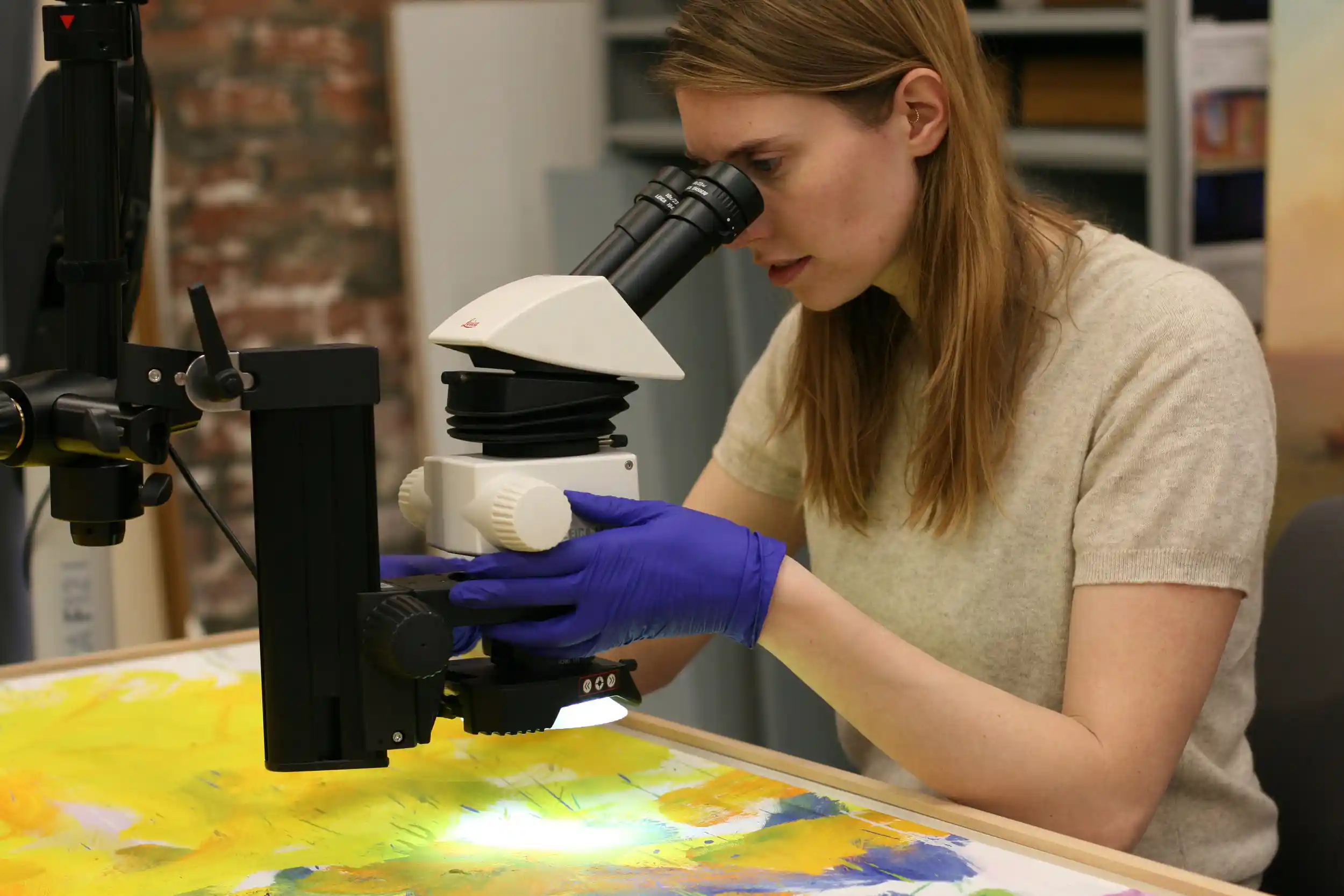
The conservation-restoration work process is a complex and interdisciplinary one, requiring advanced technical knowledge and a deep understanding of the aesthetic and historical values of the restored object. Each stage of this process is carried out with meticulous attention, to ensure that the interventions are both effective and respectful of the authenticity of the work. The first stage is a análise preliminar , in which the restorer assesses the state of conservation of the work, identifying the affected areas and the factors of deterioration. This diagnosis includes detailed visual examinations, but also scientific methods, such as microscopy , análise espectroscópica and radiography , para detectar problemas estruturais invisíveis na superfície.
Com base nessas avaliações, o restaurador elabora um plano de intervenção that describes the steps and materials to be used. At this stage, the degree of intervention required is also determined, taking into account the principle of minimal intervention and reversibility, which ensures that the changes made are delicate and can be removed without affecting the original work. This plan is often discussed and approved by a multidisciplinary team, including art historians, chemists and conservators, who collaborate to ensure a balanced and informed approach.
A etapa de limpeza é uma das partes mais sensíveis do processo de restauro, pois remove depósitos de sujidade e camadas de verniz oxidado sem afetar os pigmentos originais. Os restauradores utilizam soluções químicas e técnicas de limpeza delicadas, aplicadas gradualmente e testadas em áreas discretas para evitar reações inesperadas. Em alguns casos, a limpeza é realizada com a ajuda de lasers, um método moderno que permite a remoção precisa da camada de sujidade, protegendo os detalhes frágeis da superfície.

Uma vez concluída a limpeza, a obra é então consolidada e estabilizada . In the case of paintings, this involves reinforcing the paint layer with special adhesives, while in the restoration of sculptures or fragile objects, a supporting structure may be applied. Consolidation aims to preserve the physical integrity of the work, preventing cracks, detachments, or further damage.

A fase final do processo é retouching or reintegração cromática , in which lost details are completed to restore the visual unity of the work. Retouches are made with special paints and materials, often applied in thin and easily reversible layers, to respect the original transparency and texture. After retouching, the work is sealed with a layer of protective varnish, which protects the surface from further degradation and gives it shine.

Materiais e ferramentas
The materials and tools used in conservation-restoration are essential to preserve the authenticity and integrity of works of art. Each intervention requires a careful choice of materials, which must be compatible with the original structure and composition of the object, but also delicate enough to avoid damage. Among the most commonly used materials are adesivos reversíveis and resinas especiais , which help to consolidate fragile layers of paint or damaged surfaces. These are chosen to allow their removal in the event of a subsequent restoration, thus ensuring that the intervention is reversible and that the work can be restored in accordance with the new standards.
Além dos adesivos, soluções químicas são usadas para o delicado cleaning das superfícies, aplicadas em concentrações e fórmulas controladas para remover sujeira e depósitos de oxidação sem afetar os pigmentos originais. Para isso, os restauradores utilizam solventes suaves , neutral detergents and other cleaning substances adapted to each type of material. In some cases, for very sensitive objects, modern techniques are used, such as laser limpeza, que oferece precisão excepcional na remoção de impurezas enquanto protege os detalhes finos.
Ferramentas físicas são igualmente importantes e variadas. Pincéis finos , scalpels and spatulas são essenciais para aplicar materiais de restauração e para a remoção controlada da camada superficial. Na restauração de pinturas, pincéis extremamente finos são usados para aplicar retoques de cor e realçar detalhes delicados. Lâmpadas UV and microscopes também são usadas para analisar a estrutura interna e revelar detalhes ocultos, proporcionando profunda compreensão do processo de restauração.
Além das ferramentas, materiais de proteção are indispensable in completing the work. Protective varnishes and coatings are applied to ensure the durability of the restored object. These not only protect the surface from contaminants, but also help maintain vivid colors, giving the artwork a revitalized shine and long-term protection. Ultimately, every material and tool used in restoration reflects a deep attention to detail and respect for heritage, supporting the mission of preserving the beauty and historical value of works of art for posterity.

Técnicas de trabalho
Limpeza com solvente é uma técnica essencial em conservação e restauração, usada para remover camadas de sujeira, verniz oxidado e outros depósitos indesejados da superfície de objetos. Solventes, cuidadosamente escolhidos para serem compatíveis com os materiais originais, permitem uma limpeza suave sem comprometer a camada de tinta original. Este método requer precisão notável e conhecimento avançado de química para adaptar-se às características únicas de cada obra.

A limpeza a laser é uma técnica avançada que utiliza energia luminosa para remover impurezas, proporcionando um controlo extremamente preciso sobre o processo de limpeza. Este método permite que o revestimento original seja mantido intacto, tornando-o ideal para objetos frágeis ou de valor inestimável. O uso de lasers garante uma limpeza não invasiva e tornou-se uma técnica popular na restauração de objetos que requerem intervenção minimamente invasiva.

Consolidation é crucial para a restauração de obras afetadas por rachaduras ou áreas frágeis. Esta técnica envolve o uso de adesivos reversíveis e resinas especiais para estabilizar e fixar camadas vulneráveis de tinta. Frequentemente aplicada na restauração de afrescos e murais, a consolidação ajuda a prolongar a vida das obras de arte, preservando sua integridade estrutural.

Reintegração cromática allows the restoration of damaged or lost areas, ensuring a harmonious integration of colors, without altering the original layer. Using ultra-fine brushes and reversible colors, the restorer adds details that complete the image, thus restoring visual unity. This technique offers a temporary solution that can be removed, maintaining respect for the authenticity of the work.
Reintegração cromática usa linhas ou pontos discretos para criar continuidade visual na composição, imitando a textura e os tons originais, mas preservando a demarcação entre a intervenção e a obra original. Esta técnica permite que o público perceba a imagem de forma completa, ao mesmo tempo que protege a autenticidade, evitando intervenções invasivas. A reintegração cromática é essencial para restaurações de alta qualidade, nas quais os detalhes originais devem ser rigorosamente respeitados.

Estabilização por injeção is a technique used in the restoration of works of art with fragile layers or damaged stratifications. It involves injecting special adhesives under the paint layer or into damaged structural areas, thus preventing delamination and supporting the integrity of the object. This method allows for the maintenance of durability and structural stability, being essential in the restoration of old murals and frescoes.

Reconstrução e modelagem is a technique used to fill in missing parts in artifacts and sculptures. Reversible materials, such as epoxy resins or special clays, are used, which are molded according to the original contours of the work. Pigments are then applied to harmonize the color and texture of the new element with the rest of the work, thus completing the reconstruction with a unified and authentic appearance, without compromising reversibility.

A aplicação de vernizes protetores plays a crucial role in ensuring the longevity of restored works. Varnishes act as a shield against harmful environmental factors, including humidity, dust and UV radiation. They also preserve vivid colors and textures, providing a subtle sheen that highlights the details of the work, thus enhancing its aesthetic value and visual integrity.

Estabilização física através de suportes is essential for three-dimensional objects and fragile structures. This technique uses frames or supports that provide additional support, preventing possible structural damage. These supports are adapted to the shape and size of the object, being designed in such a way as to preserve structural integrity and prevent unwanted displacements or deformations, helping to preserve the work in a stable and intact state.
Ambiente Integrado
O ambiente integrado de conservação-restauração involves the collaboration of various scientific and artistic disciplines, such as chemistry, physics, biology, art history and archaeology, to ensure the protection and restoration of cultural heritage. This integrated approach allows for a deep understanding of the structure and composition of art objects, using both advanced scientific knowledge and artistic sensitivity. Working in multidisciplinary teams brings diverse perspectives to each project, allowing restorers to develop personalized methods and intervene in a sustainable manner, thus ensuring the durability of the works.
Enquadramento Multicultural
O enquadramento multicultural é fundamental em restauro, dado que obras de arte e artefactos provêm de diversas culturas e épocas, cada uma com a sua especificidade única. Os restauradores devem estar cientes dos significados culturais e sensibilidades envolvidas, compreendendo o simbolismo e o valor espiritual dos objetos. Num mundo globalizado, esta dimensão multicultural permite que as equipas de conservação abordem cada obra com respeito pela sua origem cultural, criando uma ponte entre tradições locais e práticas de restauro modernas. Assim, cada intervenção consegue manter e honrar a diversidade cultural do património mundial.
Contexto Social
O contexto social da conservação-restauro destaca o papel desta disciplina na educação e no fortalecimento da identidade cultural das comunidades. O restauro do património não só garante a proteção de artefactos históricos, mas também serve como meio de transmissão dos valores e da história de um povo para as gerações futuras. Além disso, a conservação opera ao serviço do público, sensibilizando a sociedade para a importância do património cultural e gerando um sentido de responsabilidade coletiva para com o património cultural. Através de exposições, visitas guiadas e documentários educativos, os restauradores contribuem para a compreensão e o respeito pela história partilhada.
Contexto Profissional
O contexto profissional em restauro é marcado por rigorosos padrões éticos, rigor técnico e a necessidade constante de inovação. Os restauradores trabalham num campo altamente especializado, onde a integridade e a transparência são fundamentais. Respeitam códigos deontológicos que garantem intervenções mínimas e reversíveis, preservando a autenticidade das obras. Profissionais desta área adaptam-se continuamente aos avanços tecnológicos e a novos métodos, participando em cursos de formação avançada e conferências internacionais. Este contexto dinâmico e competitivo estimula não só o desenvolvimento pessoal, mas também o avanço global das práticas de conservação, promovendo um alto padrão na proteção do património cultural.
Princípios Fundamentais na Conservação-Restauração
In conservation-restoration, specialists do not apply aesthetic "styles", but follow various princípios conceituais that respect the authenticity and integrity of cultural heritage. These approaches do not aim to leave a stylistic imprint on objects, but to adapt interventions to the needs of each work, preserving their historical and aesthetic value.
Abordagem mínima
Um dos princípios mais respeitados é a abordagem mínima , also known as "minimal intervention". This method emphasizes the importance of an intervention reduced to the essentials, stabilizing the work without major changes. With this approach, restorers seek to preserve as much of the original structure as possible, avoiding any unnecessary additions that could affect the authenticity of the work.

Restauração integrativa
Restauração integrativa is another key approach, focusing on the aesthetic harmony of the work, visually merging the damaged parts with the rest of the composition. This technique is frequently used in the restoration of paintings and frescoes, where subtle retouching methods are used to restore visual unity without blurring the differences between the interventions and the original. The goal is to create a complete aesthetic experience for the viewer, while the work remains faithful to the original creation.

Conservação preventiva
Conservação preventiva is a proactive approach that aims to maintain the artwork in an optimal environment to prevent deterioration over time. Here, the emphasis is on strictly monitoring and controlling storage conditions, such as temperature, humidity, and light exposure. This method reduces the need for subsequent restorations, protecting objects from potential damage and extending their lifespan.

Restauração estilizada
Restauração estilizada , inspired by the ideas of Viollet-le-Duc, brings a different perspective, attempting to fill in the missing sections to restore the integrity of the work. This type of restoration idealizes the form of the object, without compromising its historical value. Stylized restoration seeks to recreate the overall image of the work, maintaining the balance between an idealized aesthetic and respect for the past.

A conservação-restauro é um ato de profundo respeito pelo património cultural, uma disciplina que combina ciência e arte para preservar a autenticidade e a longevidade de obras de arte e artefactos históricos. Através de técnicas delicadas e abordagens rigorosas, os restauradores garantem não só a integridade física dos objetos, mas também a continuidade dos valores e tradições culturais, protegendo-os para as gerações futuras. Esta prática transcende o simples reparo, tornando-se uma forma de diálogo com o passado e um compromisso com a história partilhada, uma promessa de que estes preciosos testemunhos da humanidade permanecerão intactos, inspirando e educando na eternidade.

Monica Briciu
Redatora Publicitária
Quando escrevo, estou totalmente imersa — apaixonada, focada e no meu fluxo criativo. Quando não estou, provavelmente me encontrará cantarolando minhas músicas favoritas, desfrutando de uma longa caminhada ou perdida em um bom livro.